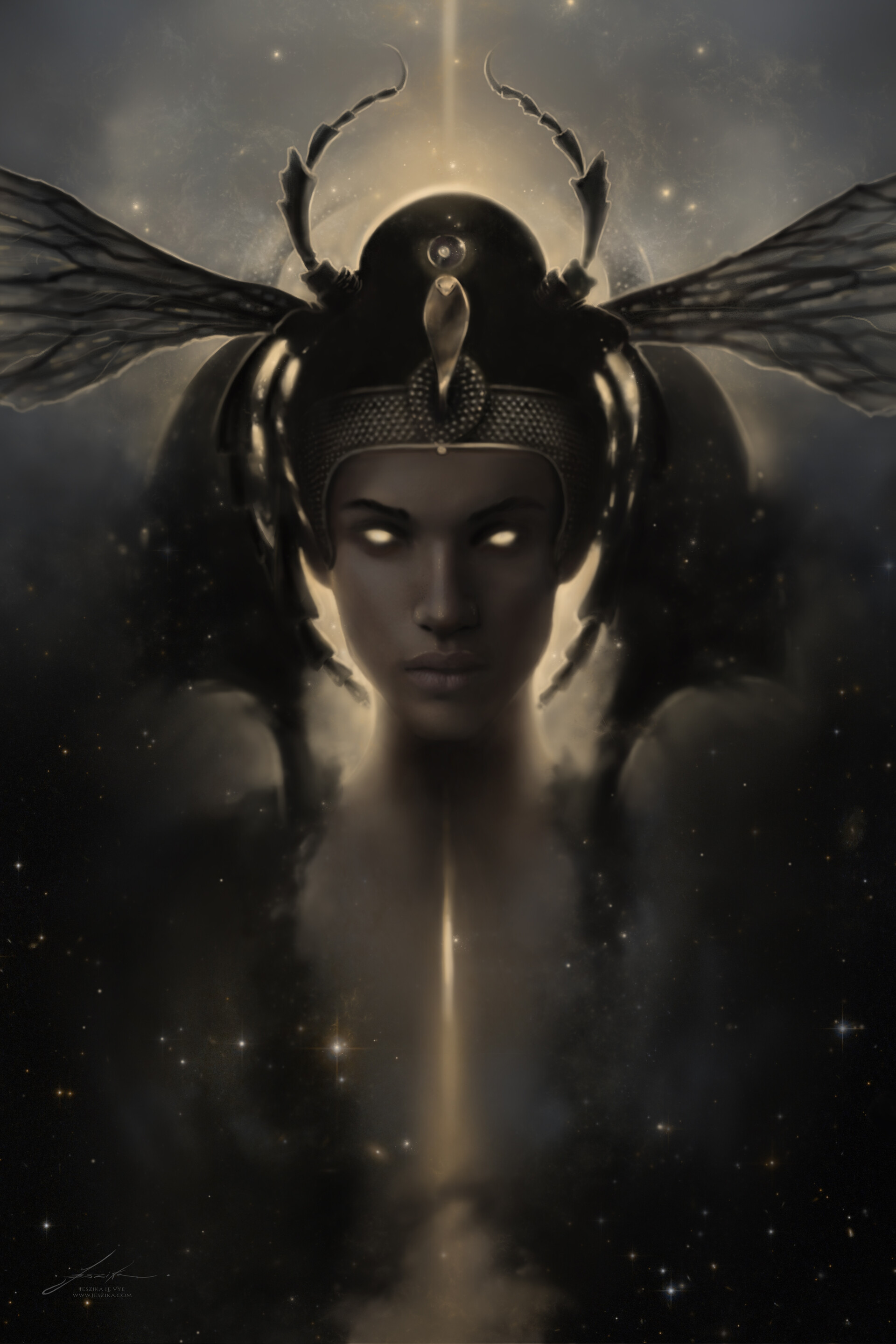
Khepra - Egyptian God of the Rising Sun
Khepra - 'The night evaporates around him, like a shroud he shrugs off the underworld, unveiling the glorious rekindling of light. The sun rises yet again.'
*
Khepra is the Egyptian god of the rising sun and represented the eternal rebirth of the day, the primordial dawning of the universe. The Egyptians had many sun gods, often described as being various incarnations of the same god. Ra, Amun and Ptah were generally considered sun gods in the sense of the noonday sun - whereas Khepra was the god of the rising sun and Atum was the god of the setting sun.
*
For each of these celestial portraits of the gods, I have chosen a cosmic symbol for them as well. For Khepra, I chose the stellar corona - the ring of light and heat that surrounds the sun and other stars. The corona of the sun is over 500x hotter than the next layer of the sun and researchers are still working to explain the mechanics of why that is. (Researchers in India have gathered evidence that it is the result of millions of nanoflares that continuously add heat to the corona.)
*
When I envisioned painting Khepra, I pictured the rim of light on the horizon, the scattering of the dark shadows as the sunlight blooms over the horizon. For Khepra, I envisioned him as the leading edge of the sun’s heat and light, burning victorious as Apep, the serpent of cosmic darkness and entropy, is vanquished. Another night has passed in which he failed to consume the sun and life and light return yet again.
*
Khepra was associated with the scarab beetle. Khepra was often shown as a scarab beetle, but in some cases, as a man with a scarab for a head or scarab with a man’s head. As a scarab, the wings of a hawk are often added, as well as a rope, gripped in hawk claws, that is formed into a loop, ‘shen’, to symbolize eternity.
*
The ubiquitousness of scarab amulets, jewelry, and art in ancient Egypt shows how integral the concept of Khepra, of rebirth, was to the Egyptians culture and thought. It is one of the most abundant symbols they used. Amulets of scarabs were used in the mummification process to represent the heart and be weighed against the feather of Ma’at. They were often inscribed with spells to not ‘bear witness against me’ for the dead.
*
The Egyptians saw the scarab beetle roll a ball of dung, the most base, and lifeless material, into a hole - where, unknown to them, the beetle would lay eggs and a young scarab would emerge, seeming to have created itself. Khepra’s name means ‘to become’ or ‘create’ and Khepra was said to be, like the other sun gods, self-created. Translations of his name also result in the noun, transformation. He symbolized the potentiality of the inert and static to become again animate. He represented an integral view of the Egyptians, that beginnings were never from naught but were a form of transformation.
*
In one spell to become Heka, the personification of magic, mastery is granted by speaking with Khepra - the personification of change and flux. And in another spell, to prevent a death, it is said you must bind the horns of Khepra - to prevent being ferried to the east, to be slain, one must stop change itself.